Is a hot sauce as hot as the pepper in it?
Nowhere near. Tabasco’s scorpion sauce comes to about 2 per cent of the scorpion pepper’s number, its green jalapeño sauce to about a sixth of the jalapeño’s. On Hot Ones’ own store, none of the 47 bottles gives a number of its own.
Ebbi · 9 November 2026
Every hot sauce on Hot Ones’ own store, at its heat out of 10, in the row of the hottest pepper it names
that pepper first on its labelfurther down the labelno pepper on the shop’s scale
Pepper X2,693,000
The Apollo peppernot yet counted
Carolina Reaper1.4–2.2 million
Trinidad scorpion1.2–2 million
Ghost pepper855,000–1,041,000
Habanero100,000–577,000
Scotch bonnet100,000–350,000
Serrano10,000–23,000
Chile de árbol10,000–20,000
Jalapeño2,500–8,000
No pepper on the shop’s scale
Each dot is one bottle on Hot Ones’ own store, read on 9 November 2026, at the heat out of 10 the show gives it, in the row of the hottest pepper its ingredients name; beside each pepper, its Scoville range by Heatonist’s guide.
Filled: that pepper comes first among the ingredients. All 47 by name, in the table to download.
Pepper X, which the shop that sells it puts at 2,693,000 Scoville units, a Guinness World Record, goes into five bottles on Hot Ones’ own store. The Last Dab: Xperience is rated 11 out of 10 for heat. Nugget Honey is rated 4.
The reason is printed on the back of each. Xperience lists Pepper X first, then vinegar, then Pepper X again as a powder and as a distillate. Nugget Honey lists honey, then gin, then Pepper X.
A pepper’s number tells you how hot the pepper is, and most people meet it on a bottle, where it reads as the bottle’s. I read every bottle on the shelf where hot sauce is watched most, to see what each says about its own heat.
Out of ten.
Hot Ones is the YouTube interview show whose guests face ten chicken wings in ten sauces, each hotter than the last. Its own store sells 47 sauces in single bottles: 16 of the show’s own, and 31 from 30 other makers.
Every one carries a heat out of 10, from 1 to 11, and every one prints its ingredients. Not one of the 47 pages gives the sauce a Scoville number.
Eight give one for the pepper inside, and one says what happens next: “Pepper X recently clocked in at 2,693,000 Scovilles, but this hot sauce recipe tones things down slightly”.
Heatonist, the New York shop that helps choose the show’s line-up, says why in its guide to the scale: “lab testing is usually limited to chilis going for the record, and not to hot sauces”. For most of its sauces it uses “a 1-10 scale”.
The makers’ own stores say no more. Of the 31 bottles from other makers, 17 have a page on their maker’s own store, and none gives the sauce a Scoville number. They give their own scales instead: 11 out of 10, 3.5 out of 10, six flames out of six, “Medium +”.
Two scales of ten don’t always agree on the same bottle. Dawson’s rates its Coffee Date 3.5 out of 10; the show rates it 1. TorchBearer rates its Sucker Punch 11; the show, 9.
Two numbers on the shelf.
Heatonist does print Scoville estimates for the line-up, on its pages for the season ten-packs. On the pages for the last two seasons, one sauce in each has one.
Los Calientes Rojo, the fifth wing of the current season, is put at 49,000. Its hottest pepper, an orange habanero, is the tenth of its nineteen ingredients.
Pickled Garlic Sriracha, from the season before, is put at 18,000. Its only pepper is the jalapeño, which the same shop’s guide puts at 2,500 to 8,000.
A sauce can’t be hotter than the only pepper in it, and this estimate is more than twice the hottest jalapeño on the shop’s own list.
Tabasco, which prints a Scoville range for its pepper sauces on its own pages, puts its green jalapeño sauce at 600 to 1,200.
Counted dry.
The number on a pepper begins with the pepper dried. Wilbur Scoville’s test of 1912 dissolved a weighed amount of dried pepper in alcohol, then diluted it in sugar water until most of a panel of five tasters could no longer feel the heat.
Labs now measure the burning molecules themselves, capsaicin and its kin, and the trade still counts them in a million parts of dried pepper. A pepper’s range on a chart is a count of that kind.
A fresh pepper is about nine parts in ten water, which the pepper’s number leaves out. In the bottle the water stays, and the vinegar, the fruit and everything else take their share as well.
That is why Tabasco’s numbers fall so far. Its scorpion sauce lists the scorpion pepper first and puts itself at 23,000 to 33,000, against a pepper Heatonist’s guide puts at 1.2 to 2 million: about 2 per cent, taking the middle of each range.
Its habanero sauce, the pepper second after vinegar, says over 7,000, beside a habanero of 100,000 to 577,000.
A pepper’s number counts the pepper dried. The bottle is mostly water.
The back of the bottle.
The one clue to a bottle’s heat printed on the bottle itself is its list of ingredients. In the United States, the law has it run from the heaviest to the lightest.
On Hot Ones’ shelf, 13 sauces list their hottest pepper first, and the middle one of them is rated 9 out of 10. Sixteen list it fifth or later, and their middle sits between 4 and 5, whatever the pepper.
The Carolina Reaper runs from 4, sixth of nine ingredients in a white mustard sauce, to 10, first in The Last Dab: Reaper Edition.
The list gives the order, never the amounts, and five of the 47 lists name no pepper at all, only words like “chili peppers” or “hot peppers”.
A number of its own.
An honest number for a bottle comes from testing the bottle, not the pepper. Even then Tabasco calls its numbers “an approximation”, and a pepper’s heat changes from plant to plant and harvest to harvest, which is why every chart gives a range.
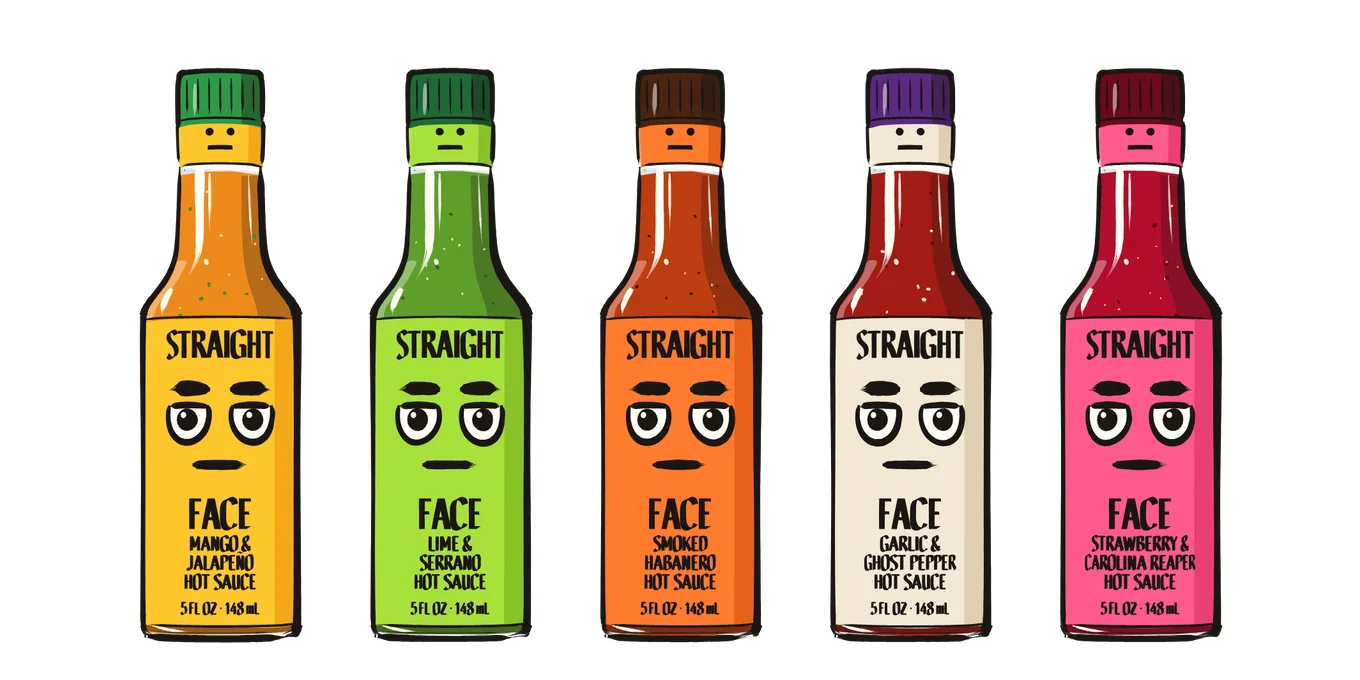
Without a test, the honest thing a label can say is the pepper’s number, marked as the pepper’s. On Straight Face, the five sauces I made, each card names its pepper’s heat and claims none of it for the bottle.
How I counted it.
The shelf: every single bottle of sauce on Hot Ones’ own store, hotones.com, on 9 November 2026, minis, packs and barbecue sauces set aside: 47 sauces. For each, its heat out of 10 and its ingredients, as its own page gives them.
The makers: for the 31 bottles from other makers, each maker’s own online store where I could find one, read the same day for anything it says about its sauce’s heat. The two estimates: Heatonist’s pages for its Season 31 and Season 30 ten-packs.
A sauce’s hottest pepper: the hottest it names among its ingredients, by Heatonist’s own guide to peppers; its place: where that pepper stands in the list. Tabasco’s numbers: its own pages, the same day, set against Heatonist’s guide by the middle of each range.
What the count cannot show.
How hot any bottle is: nothing here was tasted or tested, and a heat out of 10 is its rater’s own judgement. One shelf on one day; stores change. Twelve of the 30 makers have no store of their own that I could find, so for their bottles I had only the show’s page.
The amounts behind a list: the law lets the ingredients that make up 2 per cent or less of a food close the list in any order. For a lab’s own numbers on one season’s line-up, Howtown tested the sauces of Hot Ones in December 2024, as kottke.org reported.
The count, to download.
All 47 bottles, each with its heat out of 10, its peppers in the order its label lists them, what its maker’s own store says of its heat, and the address of every page, as a table to download, free to reuse with credit (CC BY 4.0).
If a re-count changes a number, it will say so here, with its date.
To cite. Ebbi, “Is a hot sauce as hot as the pepper in it?”, ebbi.ai/seen/is-hot-sauce-as-hot-as-the-pepper/, 9 November 2026.
Sources. Every page read on 9 November 2026.
- Hot Ones, its own store, and the page of each of its 47 sauces
- Heatonist, “The Scoville Scale Explained” · its pages for the Hot Ones Season 31 and Season 30 ten-packs
- The makers’ own stores: 17 pages, each named in the table
- Tabasco, its sauces’ own pages and their Scoville chart
- Code of Federal Regulations, Title 21, § 101.4, “Food; designation of ingredients”
- Wikipedia, “Scoville scale”, for Scoville’s test of 1912 and the trade’s unit, after Collins, Wasmund and Bosland, HortScience 30, 1995
- Guinness World Records, “Hottest chilli pepper”
- kottke.org, “Fact-Checking the Spiciness of ‘Hot Ones’ Sauces”, 3 January 2025