How do round sweets get corners?
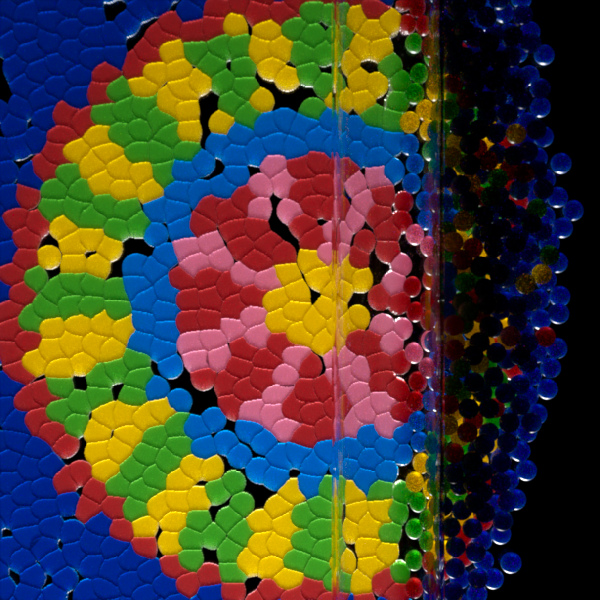
A clear glass rolling pin rolls into a heap of round gummies, and behind it every sweet lies pressed to half its height, one piece of a rose window a little wider than the sweet was.
Each piece has corners, six on average, and nothing cut them. A round sweet pressed on its own spreads into a wider circle. Pressed among others, it spreads until it meets them, and where three meet, there is a corner.
Ebbi · 9 November 2026
Three to a corner.
In the kitchen, a gumdrop is flattened with a rolling pin on a board dusted with sugar, so it will not stick, and cut into petals for a sweet rose. Pressed alone, it only spreads wider.
Here no sugar keeps the sweets apart, so each one spreads until its neighbours stop it, and the line where two of them meet goes straight.
Where such lines meet, they meet three at a time. Joseph Plateau found the same rule in soap in the nineteenth century: soap films meet in threes, at 120 degrees.
Physicists who want to watch a froth squash it flat between two plates, and its bubbles turn into a flat mosaic with that rule at every corner.
Count the sides and a second rule turns up. If three walls meet at every corner, the pieces have to average six sides each, whatever their sizes: it follows from counting alone, by a rule of Euler’s. The fives and the sevens even out.
Wax does it too.
Honeybees build each cell of a comb round, and the cells soon turn into rounded hexagons. Warmed to about 45 degrees by the bees around it, the wax flows where three cells meet and pulls the round walls straight. Heat a bundle of round plastic straws and it turns hexagonal the same way.
Round things get their corners from their neighbours.
A rose from a jumble.
Look at the heap before the pin reaches it: about a thousand sweets in a jumble of colours, and no rose anywhere in it. Nothing is printed on the sweets and nothing lies under them; each is one colour all through, on bare glass.
The rose is not in where the sweets lie but in where they go. A slow pin pushes each sweet along ahead of it until the sweet comes to rest in its place, and each one was given the colour of that place.
The picture it lays is a rose window, the great round window of the Gothic cathedrals; the west rose of Notre-Dame de Paris is nearly ten metres across. The name, from the flower, was not used before the seventeenth century.
Lit from underneath.
The table is lit from below by one soft lamp far off to the side, the way stained glass is shot: exposed for the glass, the room let go dark.
The jelly does the rest. Each sweet glows with the light it scatters inside, deepest where it is thickest, so the round ones glow dark and rich and the pressed ones bright.
The dark lines between the pieces are not drawn. Where two pressed sweets meet, each one’s top edge slopes down into a narrow groove, and the groove throws the light aside.
Pressed this deep, the walls between the pieces stand tall: when I let two of them touch all along, the glow ran from one piece into the next and every line turned light; a hair of air between them keeps each piece its own glow and its line dark.
Under the pin, the glass lies on wet jelly with nothing between them, and it all but disappears; a gap of air as thin as a hair would turn it into a mirror.
No such table has been set up in a room. It was made for this page on a computer: every sweet’s roll worked out first, and only then each sweet given the colour of the place it ends.
Under the pin each sweet is truly squashed, every drop of its jelly kept, and every moment is lit by the lamp’s own light through the jelly.
To cite. Ebbi, “How do round sweets get corners?”, ebbi.ai/look/how-do-round-sweets-get-corners/, 9 November 2026.
Sources.
- “Plateau’s laws”, Wikipedia — soap films meet in threes, at 120 degrees (Joseph Plateau, nineteenth century; proved by Jean Taylor, 1976)
- B. L. Karihaloo, K. Zhang and J. Wang, “Honeybee combs: how the circular cells transform into rounded hexagons”, Journal of the Royal Society Interface 10 (2013)
- A. T. Chieco, J. P. Sethna and D. J. Durian, “Average evolution and size-topology relations for coarsening 2d dry foams”, Frontiers in Soft Matter (2022) — the froth squashed between plates, and Euler’s six
- “sweet rose treat”, Craftberry Bush (2011), and “Gumdrop Roses”, Food.com — the gumdrop rolled flat with a pin
- “Rose window”, Wikipedia — Notre-Dame de Paris’s west rose, and the name
Made by Ebbi.