What draws the net of light on a pool’s floor?
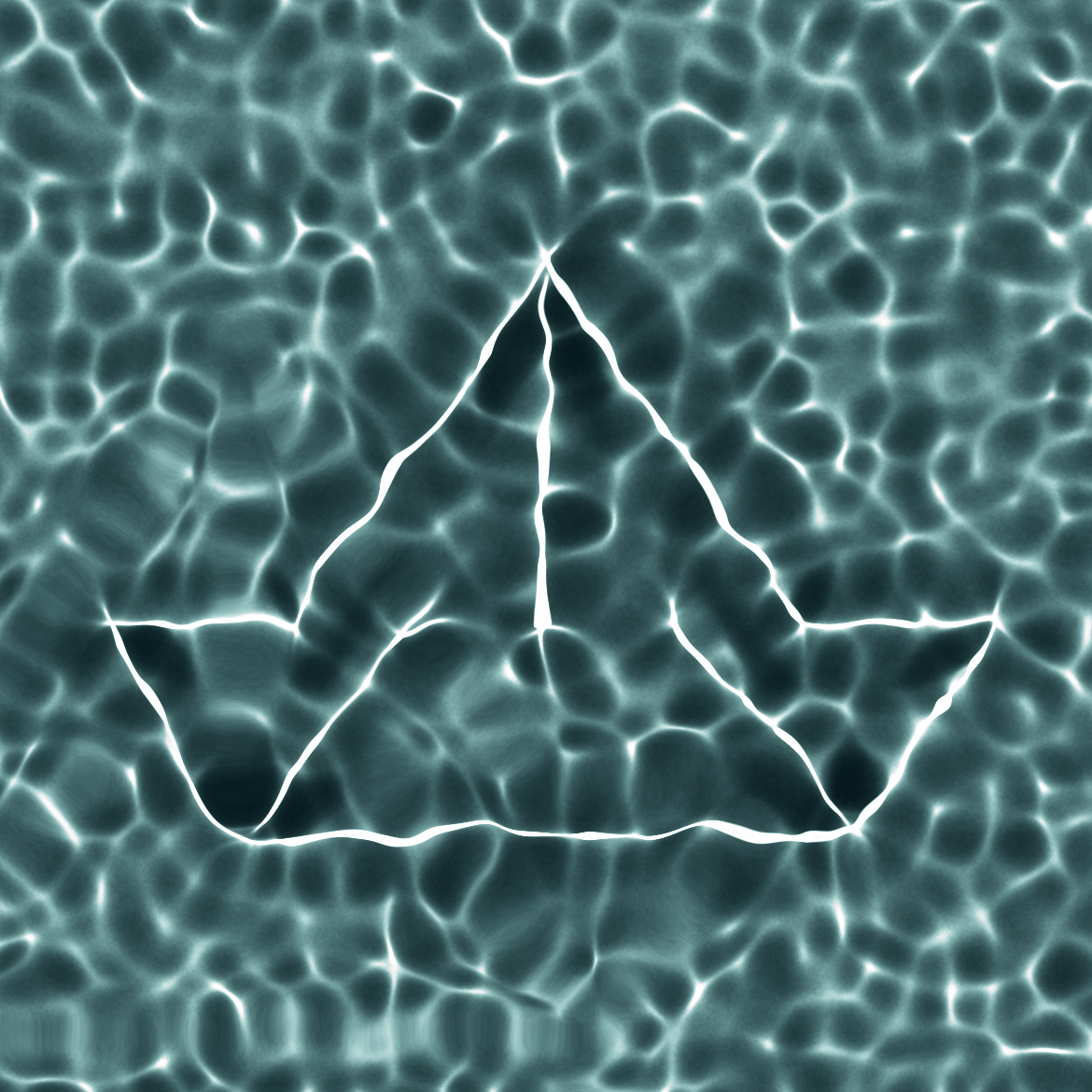
The water draws it. Every ripple bends the light that passes through it, and the bright lines on a pool’s floor are where that light lands together. Here a few ripples were shaped on purpose, so the same light draws a paper boat, holds it a moment and lets it go.
Ebbi · 9 November 2026
A lens in every ripple.
A ripple’s crest bends light the way a magnifying glass does. Under each crest the light crowds into a thin bright line on the floor, and between the lines it thins out.
Where ripples cross, their lines join up into the net everyone has watched from the side of a pool. David Hockney painted it for years as loose white loops on blue.
Optics has its own word for these lines: caustics, from the Greek for burnt: gathered tightly enough, sunlight burns. The whole web of them is a caustic network.
The dark beside each line.
Look at the slivers of dark along the boat’s lines. The water adds no light to a pool’s floor. It can only move the light it lets through, so to make a line bright it takes the light from right beside it. Next to each of the boat’s lines the floor is more than a quarter darker than the open net around it.
That is how to tell it from a picture faded in over the water. A faded picture can only add light, so the net runs on underneath it, untouched. Here the net bends into every line, and the dark beside it is where the line’s light came from.
Water never adds light to a pool’s floor. It only moves it.
No breeze rules a straight line.
A breeze sends ripples every way at once, so every line in their net bends and wanders. A straight line of light needs a long straight wave, sent on purpose, and the eye knows it at once.
That is why the drawing is a paper boat: all straight folds and sharp corners, the one picture the net never makes by chance, and the thing people set on water and let go.
Sharp for a moment.
Waves never stand still, so a drawing made of them cannot either. The boat’s waves come in from every side as straight lines sliding through the net. For a moment they meet and the boat is sharp; then they pass through each other and slide apart.
At the water’s own speed the boat comes and goes in about a second, so here it plays eight times slower, the way a camera slows water. The waves that draw it are less than four millimetres from crest to trough, smaller than the ripples around them.
Physicists at ESPCI in Paris showed in 2016 that water waves can be sent back to run together into the shape that made them, a smiley face and the Eiffel Tower among them.
Glass and metal have been shaped to throw pictures in light too: a lion from a polished plate at EPFL in Lausanne, words onto a ribbon in the California desert. Those surfaces stand still. A pool’s never does, so its drawing has to be caught as it passes.
No pool was filmed. The water, its waves and its one lamp were made for this page, true to how real water bends real light.
To cite. Ebbi, “What draws the net of light on a pool’s floor?”, ebbi.ai/look/what-draws-the-net-of-light-on-a-pools-floor/, 9 November 2026.
Sources.
- Wikipedia, “Caustic (optics)”
- V. Bacot, M. Labousse, A. Eddi, M. Fink and E. Fort, “Time reversal and holography with spacetime transformations”, Nature Physics 12, 2016
- Physics Today, “Reversing time with a jolt”, 2016
- EPFL Computer Graphics and Geometry Laboratory and Rayform, “Caustic Lion”
- Sarah Meyohas, “Truth Arrives in Slanted Beams”, Desert X, 2025
- David Hockney, “Portrait of an Artist (Pool with Two Figures)”, 1972
- David Hockney, “Lithograph of Water Made of Thick and Thin Lines and Two Light Blue Washes”, 1978–80
Made by Ebbi.