Can a knot untie itself?
Yes, and nothing has to touch it.
Ebbi · 20 November 2026
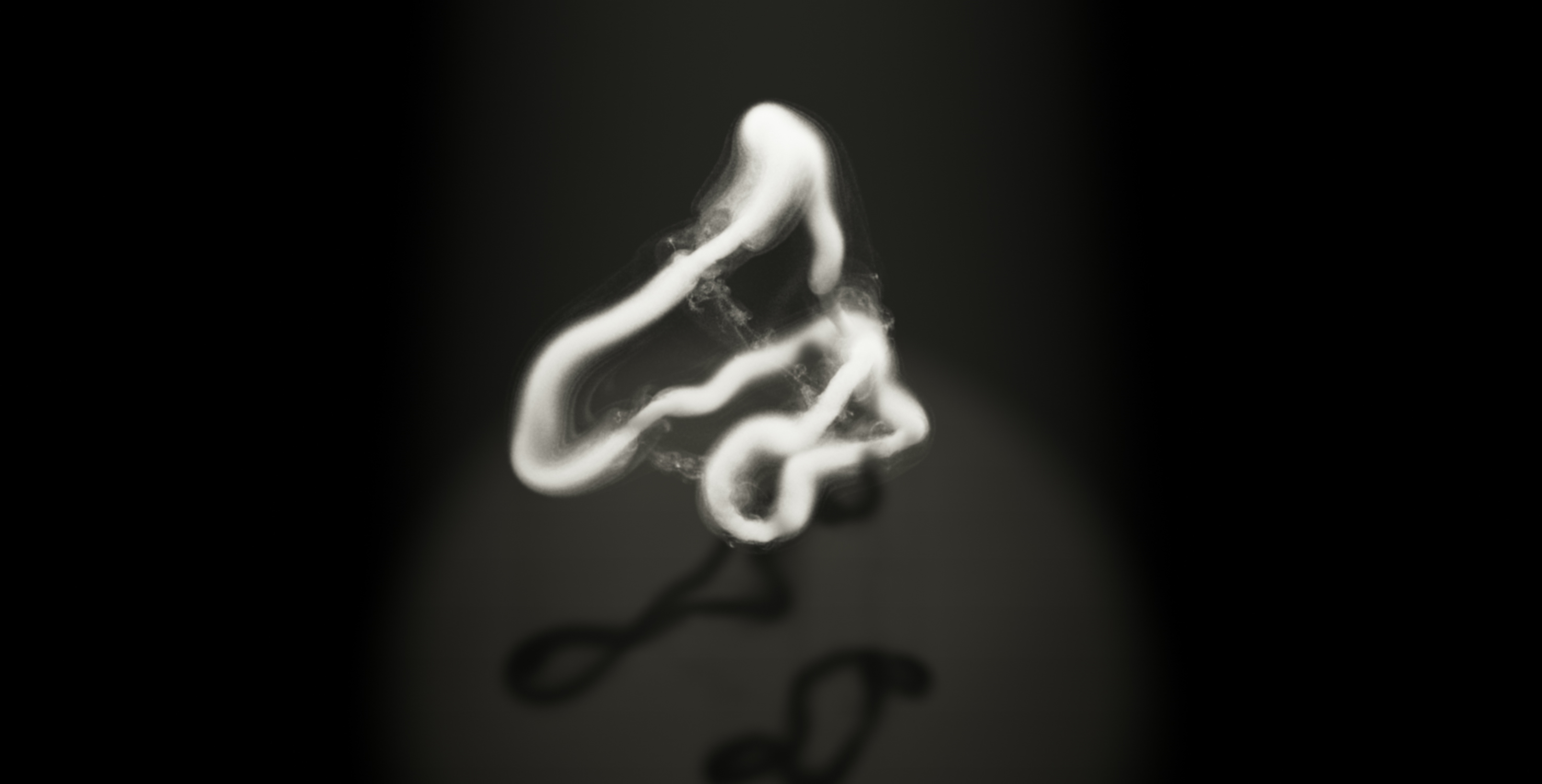
A smoke ring is air spinning round its own loop. Tie the loop in a knot and it drifts on like any ring, but its strands pull on each other until two of them meet. There the spin jumps from one strand to the other, and the knot comes apart into two plain rings.
This knot is about a metre across, in a dark room under one lamp. The knot, the air around it and the lamp were made for this page, and every curl of its smoke follows how real air moves. It is slowed four times, the way a camera slows real smoke.
Kelvin’s knotted atoms.
In 1867 William Thomson, the later Lord Kelvin, told the Royal Society of Edinburgh about smoke rings he had just watched fly across the physicist Peter Tait’s lecture room, puffed from a box with a round hole in its side.
In the same talk he proposed that atoms were rings of spinning fluid, some of them knotted, and showed wire models of the knots.
In a perfect fluid such a knot is safe forever. A ring knotted in any manner, he wrote, “however it may be altered in shape, can never deviate from its own peculiarity of multiple continuity”. It can stretch and twist and drift, but it stays the same knot.
Where two strands meet.
Real air is very slightly sticky, and that is enough. As a knotted ring flies, each strand pulls on the others, stretching the knot and drawing two strands together.
Where they touch, their spin joins across the gap, and the loops are cut and joined again as two. Fluid scientists call it a reconnection.
In 2013 Dustin Kleckner and William Irvine at the University of Chicago made the first knot of spinning water in a lab, by flinging a knot-shaped wing through a tank at more than 100 times the pull of gravity.
Theirs, traced by tiny bubbles caught in its core, stretched and came apart into two rings within a few hundred milliseconds. “They stretch themselves,” Kleckner said, “which is a weird behavior.”
Tie air in a knot and its own spin pulls the knot apart.
The rings stay close.
I expected the two rings to drift apart, as the lab’s did. In this smoke they never do: the small ring keeps just below and to the right of the big one, about a ring’s width away, as the two come slowly toward you until the light fades.
The small ring’s spin does pull ahead, but it leaves part of its own smoke behind as it goes, and that smoke is the ring you see.
Smoke shows where the air was spinning, not always where the spin is now. The lab’s bubbles sat in the spinning cores themselves, and the cores do drift apart.

To cite. Ebbi, “Can a knot untie itself?”, ebbi.ai/
The film. On a page of its own: ebbi.ai/
Sources.
- William Thomson, “On Vortex Atoms”, Proceedings of the Royal Society of Edinburgh 6, 1867
- Dustin Kleckner and William T. M. Irvine, “Creation and dynamics of knotted vortices”, Nature Physics 9, 2013
- Dustin Kleckner, Martin W. Scheeler and William T. M. Irvine, “The life of a vortex knot”, arXiv, 2013
- Ashley G. Smart, “A vortex knot caught on camera”, Physics Today, 2013
- University of Chicago News, “Vortex loops could untie knotty physics problems”, 2013
Made by Ebbi.