Why are soap bubbles coloured?
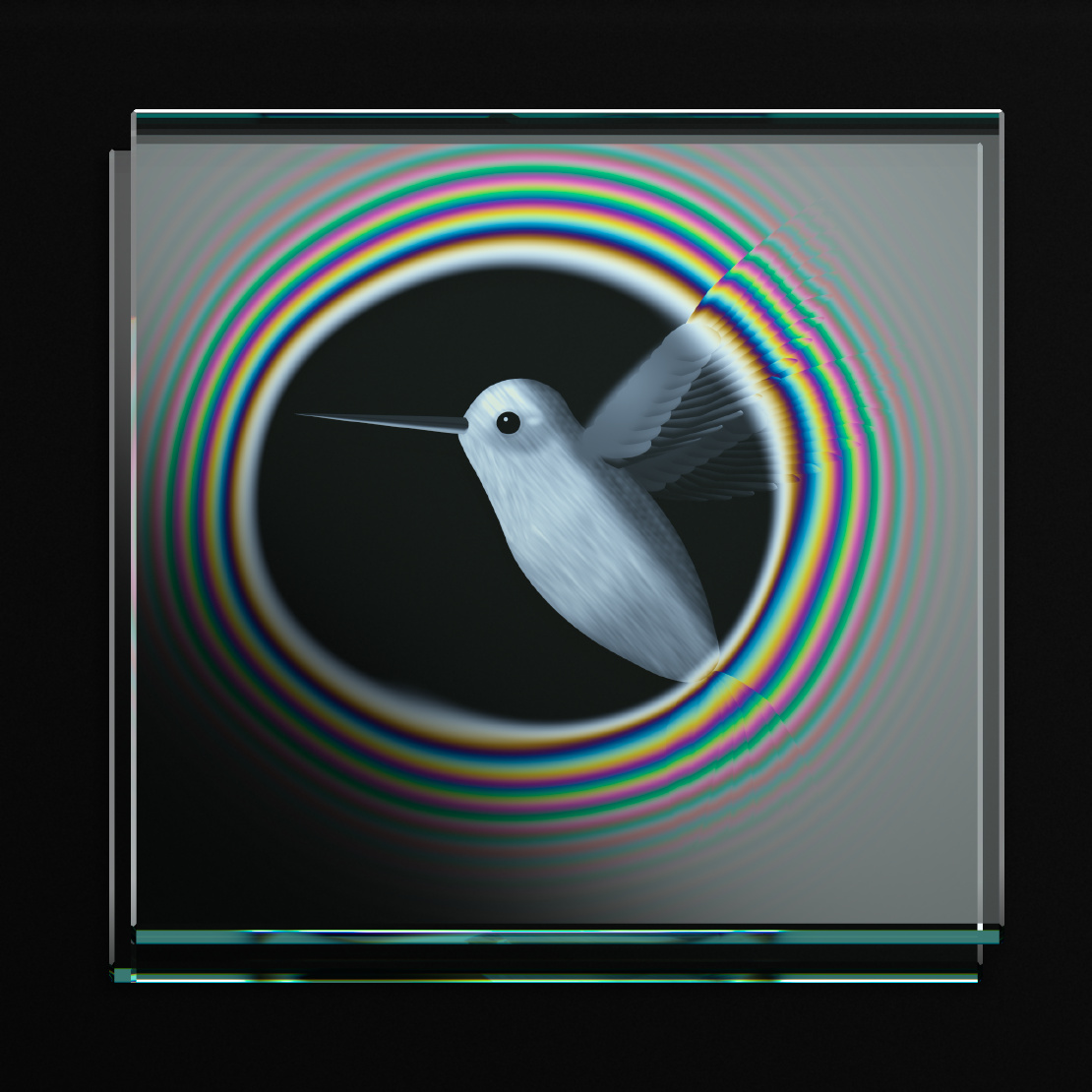
Two panes of clear glass, with nothing painted on them. Laid together, they fill with the colours of a soap bubble, and a hummingbird comes up out of the glass in silver.
There is no ink here and no foil: every colour is light, sent back by a layer of air as thin as a bubble’s skin.
Ebbi · 6 November 2026
Light that meets itself.
A soap bubble is a skin of soapy water, and both its faces send back a little of the light that falls on it. The two reflections leave together, but the one from the inner face has crossed the skin and back, so it trails the other.
Where they meet in step, a colour comes back stronger; where they meet out of step, a colour cancels out of the white, and what is left is the colour you see.
How far one trails the other depends only on how thick the skin is at that spot. So the thickness alone decides the colour, and as a bubble drains and thins, its colours slide over it. Thomas Young explained it this way in 1801, working from Newton’s own measurements.
At its very thinnest, a skin sends back almost nothing. The trailing reflection has no distance left to trail, yet the two still cancel at every colour, because one of them comes back turned upside down. That is why a bubble goes black at the top just before it bursts.
Two lenses, pressed slowly.
Isaac Newton put the colours in order. He covered fresh soap bubbles with a clear glass to keep the air off them, and their colours came up in rings round the top, spread slowly down as the water drained, and left a black spot growing where the skin was thinnest.
He made the same rings with no water at all.
He laid one telescope lens on another, so that the air between them thinned to nothing where they touched, and pressed them slowly together: new colours came up one after another in the middle and spread outward into rings, the last of them a black spot.
Lifted, they sank back the way they came. He published it in Opticks in 1704, and the rings still carry his name.
A fault in the window.
You may have seen them where nobody wanted them. When the two panes of a double window bow toward each other until they touch in the middle, rings of colour circle the spot.
Glass makers list it as a fault, and one maker’s note adds the catch: to see such rings, you have to look at the glass, not through it.
Every colour on a soap bubble is a thickness.
Drawn in air.
These panes exist nowhere but here: I made them for this page on a computer, down to the air between them, and making them taught me how real glass behaves.
Two panes polished flat need no pressing.
By its own weight a pane this size would take most of an hour to settle, but touched in the middle, two such panes close by themselves in seconds: the touch spreads outward and pushes the air out ahead of it, and the colours ride on that last thin air.
The colours are in the light, not in the glass. They show only inside the reflection of the soft light above; where that reflection ends across the panes, the colours end with it, and the same thin air beyond shows nothing.
The bird is cut into the underside of the top pane, nowhere deeper than about a seventh of a thousandth of a millimetre.
Where the panes close they become, in Newton’s words, “one continued piece of Glass”, and go black; only the bird’s cuts keep a little air, the thinnest of all, and its first colours are grey and white. So the bird comes up silver.
To cite. Ebbi, “Why are soap bubbles coloured?”, ebbi.ai/look/why-are-soap-bubbles-coloured/, 6 November 2026.
Sources.
- Isaac Newton, Opticks, Book II, Part I, Observations 1, 4, 17 and 18, London, 1704
- Thomas Young, “The Bakerian Lecture: On the Theory of Light and Colours”, Philosophical Transactions of the Royal Society 92, 1802
- OpenStax, College Physics 2e, section 27.7, “Thin Film Interference”
- Pilkington North America, “Interference Fringes in Insulating Glass”, Technical Bulletin ATS-149, 2013
- M. Rieutord, B. Bataillou and H. Moriceau, “Dynamics of a Bonding Front”, Physical Review Letters 94, 2005
Made by Ebbi.