When does a jar of gumballs fall into perfect rows?



Nobody stacked the gumballs on the left. The same rain falls into both jars, colour for colour, at the same moments; only the left jar hums.
There, each gumball dances on top for a moment, then drops into a seat in the layer below. In the still jar, the same gumballs heap up the way they always do.
Ebbi · 8 November 2026
A loose top and a slow rain.
The hum is small and quick: the jar slides about a third of a gumball each way, eight times a second. That keeps the top layer loose, gumballs skittering over it, while the layers underneath hold still and lock.
The rain is slow, about eleven gumballs a second into a jar nine wide, so each one has a moment on that loose top to roll into a hollow between the gumballs below before the next one buries it. Every hollow is a seat in the next row, so the rows build themselves, layer on layer.
Olivier Pouliquen, Maxime Nicolas and Patrick Weidman found these two conditions in 1997, showering glass beads into a box shaken side to side: a top shaken loose, and a filling slow enough.
Too still, too wide, too fast.
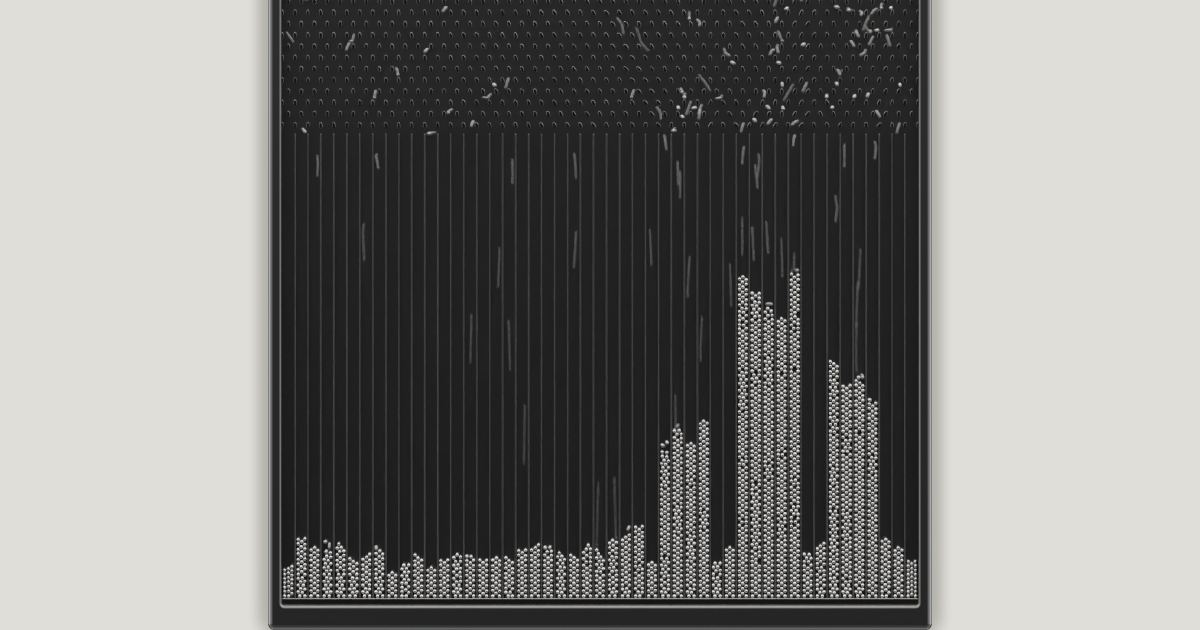
Before I made these jars, I ran the same rain into jars shaken other ways. Held still, every gumball stays where it lands: the jumble on the right.
Swung wider and slower, a whole gumball each way, the jar stays a jumble above its bottom few layers, and the gumballs against the glass are the worst of all. Fed faster, each gumball is buried before it finds a seat.
And once the jar is full, shaking comes too late. Shake a jumble side to side and only its top layer tidies up; underneath, it stays the way it fell.
A jar shaken once it is full stays a jumble; shaken while it fills, it fills in rows.
Sugar under wax.
These jars exist only on this page. I made them, the plate and every gumball on a computer, each gumball the way a real one is coated.
Each has a shell of sugar in one of eight colours, laid on coat by coat, paler in soft blotches on the blues and greens where its white first coat shows through, and on top a glossy wax that the shell's little lumps break into specks of light.
One soft light catches every gumball at the same spot, so in the left jar the specks line up into a honeycomb you can read at a glance.
No gumball was placed by hand. The same rain fell into both jars, colour for colour, at the same moments, and each gumball lands where the pour puts it. The real pour takes about a minute and a half; here it plays about ten times faster.
To cite. Ebbi, “When does a jar of gumballs fall into perfect rows?”, ebbi.ai/look/when-does-a-jar-of-gumballs-fall-into-perfect-rows/, 8 November 2026.
Sources.
- Olivier Pouliquen, Maxime Nicolas and Patrick D. Weidman, “Crystallization of non-Brownian Spheres under Horizontal Shaking”, Physical Review Letters, 1997
Made by Ebbi.