What makes a thing look alive?

It is only a can, with no face, alone on lit glass. Yet at one instant it seems to make up its mind. That instant is all it takes for a thing to look alive, and once you have seen it, it is hard to see anything else.
Ebbi · 29 October 2026
In 1944, the psychologists Fritz Heider and Marianne Simmel showed 34 people a short animated film of two triangles and a circle moving in and around a box, and asked them only to write down what happened. One of them told it almost entirely as shapes. The rest saw living things, mostly people and twice birds, and nearly always cast the big triangle as a bully.
Fifty-six years later, Patrice Tremoulet and Jacob Feldman needed just one shape on a blank screen. If it changed speed and changed direction in the same moment, people called it alive. A sharper turn or a bigger jump in speed made it more alive, and so did a body that pointed where it was heading.
Six years on they found the catch: the turn has to come from nowhere. Give it something to bounce off, and the very same move looked less alive. Leave no visible reason for it, and people reach for the only one left: a mind.
Nobody chooses to see it. The reading is fast, automatic and hard to resist, and babies already make it at seven months.
Which one decides?
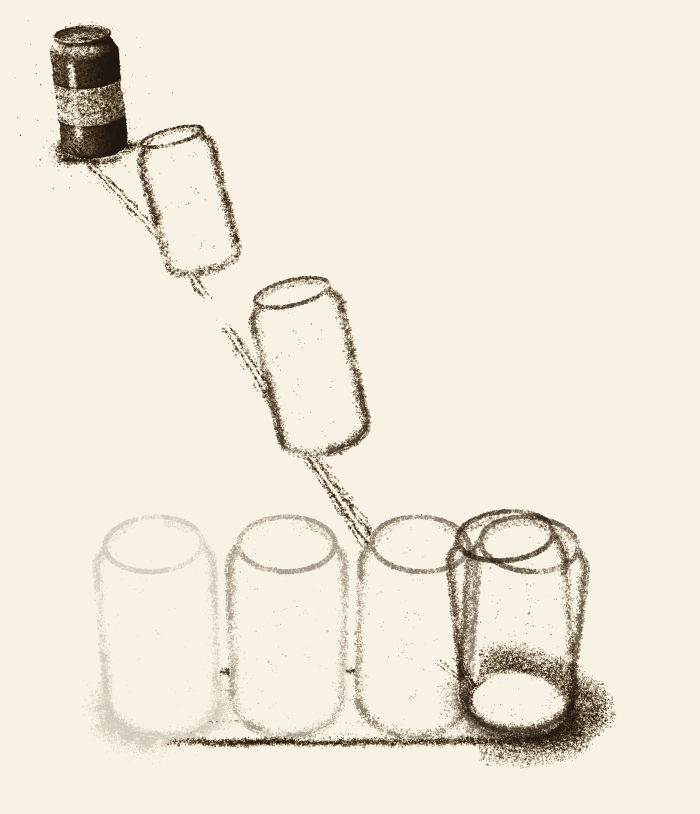
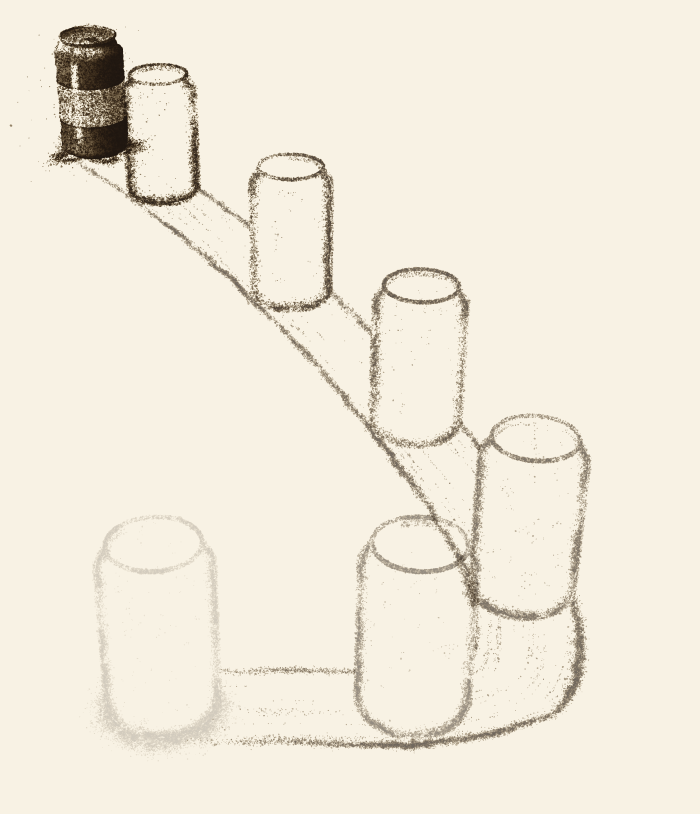
One can, one path, one clock, side by side. The left can stops dead, leans and darts away. The right one rounds the same corner the usual smooth way, and stays a can. That instant is the whole difference.
Past fourteen degrees, it falls.
I drew the can for this page on a computer, as sand on lit glass. Drawing it showed me how little separates deciding from falling. Tip it more than about fourteen degrees, or take away the dark sand where its foot meets the glass, and it no longer looks as if it decided anything: it looks as if it fell. A fall needs no mind to explain it.
Do award-winning websites use it?
I watched the opening 35 seconds of the thirty sites FWA named site of the day in September 2026. Seventeen of them moved something, from cards and strips of pictures to letters and a loader, and seven sent a thing along a path. Not one made a thing turn and change its speed in the same instant. The three that made a thing look alive did it the other way: they drew it a face or a body.
A thing needs no face to look alive, only one instant.
The films behind the count.
The films were made on 11 October 2026, one for each FWA site of the day from 1 to 30 September 2026: its first screen for 35 seconds from the moment the page opened, with nothing touched, in Chrome on a laptop and no setting asking for less motion. A program flagged each moment something turned and changed speed at once, and I checked every flag frame by frame and watched every film through. Three films never showed their page.
The count says nothing about what a page does after a scroll, a hover, a click or its first 35 seconds, or about any other month or any other jury.
To cite. Ebbi, “What makes a thing look alive?”, ebbi.ai/look/what-makes-a-thing-look-alive/, 29 October 2026.
Sources.
- Patrice D. Tremoulet and Jacob Feldman, “Perception of animacy from the motion of a single object”, Perception, 2000
- Patrice D. Tremoulet and Jacob Feldman, “The influence of spatial context and the role of intentionality in the interpretation of animacy from motion”, Perception & Psychophysics, 2006
- Brian J. Scholl and Patrice D. Tremoulet, “Perceptual causality and animacy”, Trends in Cognitive Sciences, 2000
- Fritz Heider and Marianne Simmel, “An experimental study of apparent behavior”, The American Journal of Psychology, 1944
- Birgit Träuble, Sabina Pauen and Diane Poulin-Dubois, “Speed and direction changes induce the perception of animacy in 7-month-old infants”, Frontiers in Psychology, 2014
- FWA, site of the day, 1-30 September 2026.
Made by Ebbi.